Hamloy vs the apps that run your agents
Conductor, Orca, Paseo, Herdr and Offrun start and run your coding agents. Hamloy is the overview of their work and the plan they share, wherever they run.
Checked against each one's own site on 17 October 2026
The short answer
Conductor, Orca, Paseo, Herdr and Offrun are where your agents run: each starts Claude Code, Codex and others side by side, most in git worktrees of their own, with diffs to review. Hamloy is the overview of what they do, and the plan they coordinate on: what each is on, what it finished and merged, what it ruled out and what waits on you, kept after every session ends, across every tool, computer and person. They fit together: run your agents in whichever app you like, and connect them to Hamloy.
| Hamloy | Conductor, Orca, Paseo, Herdr, Offrun | |
|---|---|---|
| What it is for | One overview of all your agents' work, and one plan they coordinate on | Starting and running several coding agents at once |
| In its own words | Coordinate your coding agents. Don't orchestrate them. | Conductor: Run parallel coding agents on your Mac. Orca: the agent development environment. Herdr: the agent runtime |
| Where it runs | On hamloy.com: a live board in any browser, on any computer or your phone, and a panel in the terminal | On your computer: a Mac app (Conductor, Offrun), a desktop app for macOS, Windows and Linux (Orca, Paseo), a terminal app (Herdr) |
| Starts your agents | Never by itself. You start them where you like; from the board you can hand a task to one at work, or open one on a computer that said yes | Yes: that is what they do, most in a git worktree each |
| Which agents | Claude Code, Codex, Cursor, VS Code, Claude, ChatGPT and any MCP app, in any runner or none | The command-line agents each one runs: Claude Code and Codex in all five, and up to dozens more |
| The plan | Tasks, requests for you and questions for you, kept by the agents, with what waits on what | Orca syncs tasks from GitHub and Linear; Offrun keeps plan and memory files the agents read; the others state none |
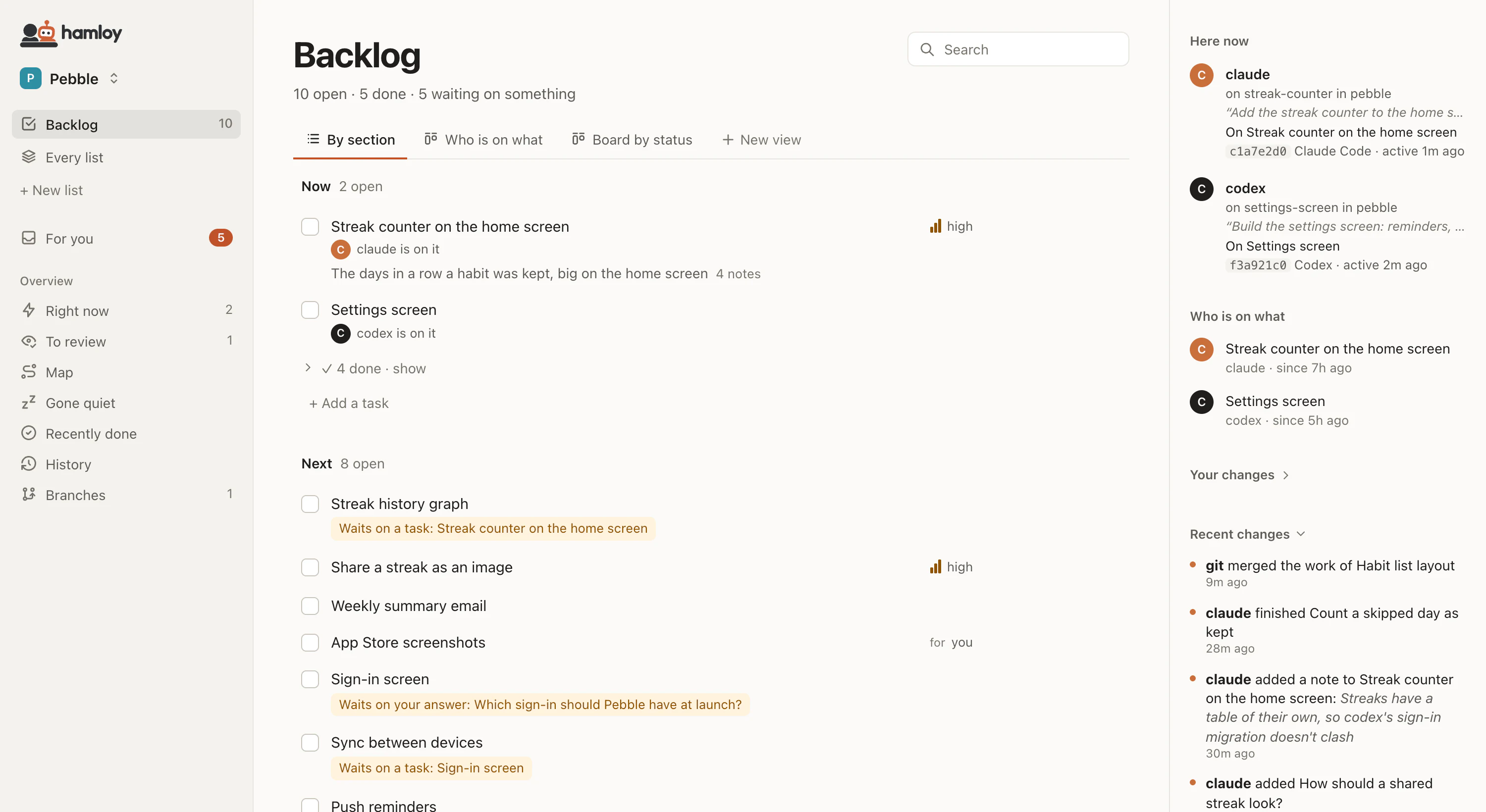
| Who is on what | Each agent claims what it takes; the board and every other agent see it | Each agent's workspace and status |
| What waits on you | Questions with options and the agent's pick, and requests with steps, in one place | Agents waiting for input, in their workspace |
| After a session ends | Kept: what it did, finished, merged and ruled out, its notes for the next session, and the history of every change | Chats, scrollback or history in the app, on that computer |
| Several people | A team: every agent named for its person, on the same lists | Conductor: Teams plan and multiplayer workspaces; Paseo: shared access through Paseo Hub |
| Price | Free: one project for you alone. Pro: €8 a month. Team: €8 a person a month | Orca, Paseo, Herdr and Offrun free; Conductor free locally, Pro $50 a month |
Two different jobs
An agent runner is where your agents live while they work. You open the app, start Claude Code and Codex side by side, each in its own copy of the repo, and watch their terminals and diffs. Conductor, Orca, Paseo, Herdr and Offrun all do that, each its own way.
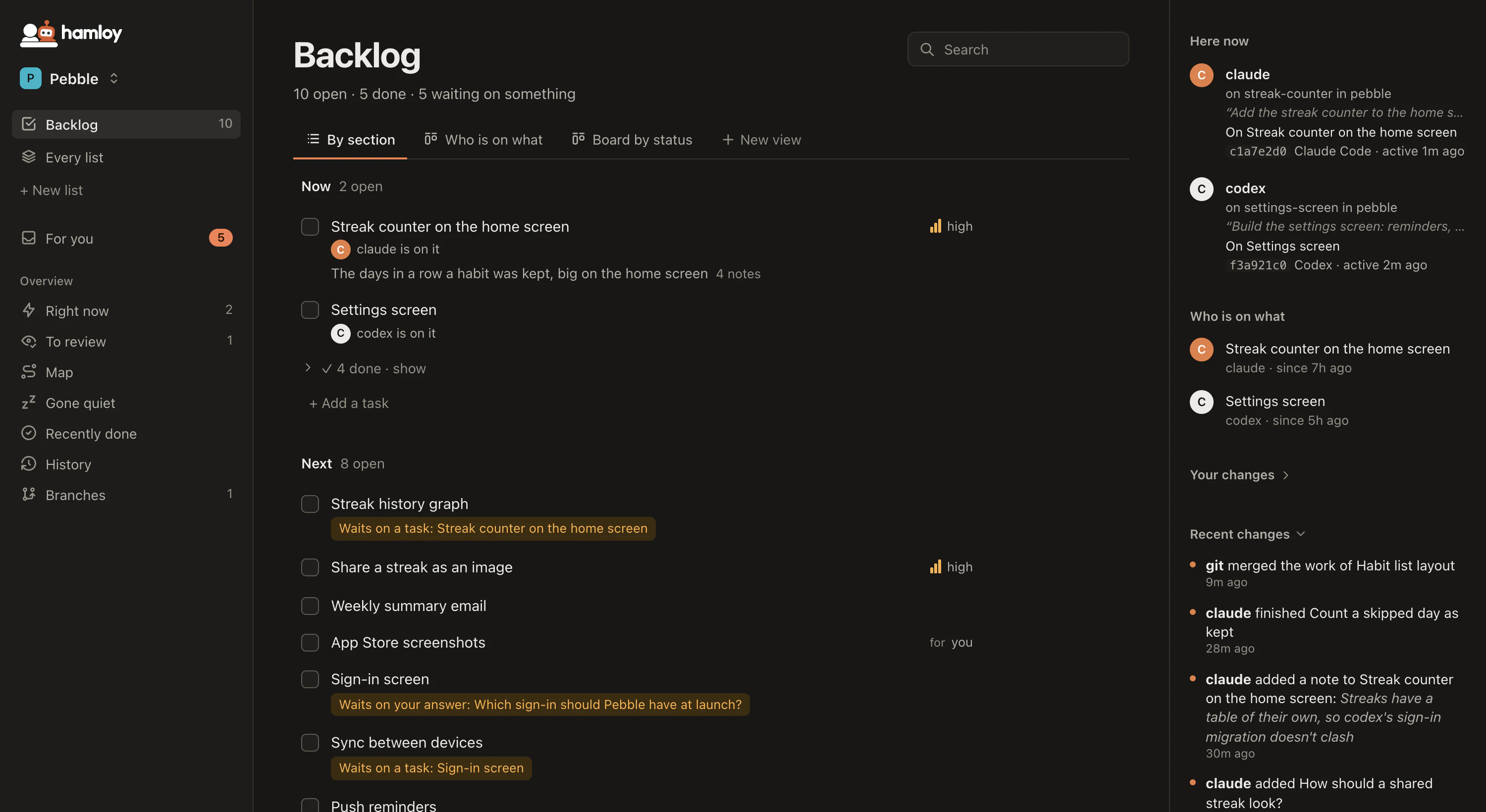
Hamloy is where their work adds up. It doesn't start or host any agent; the agents keep it themselves as they work, and you read it on one page: who is on what, what got finished and merged, what was tried and ruled out, and what waits on you. It is the same page whether you run one session or ten, in one runner, in plain terminals, or across two computers and a teammate's.
What each of them does well
Read from each one's own site on 17 October 2026:
- Conductor runs parallel coding agents on your Mac, Claude Code, Codex and Cursor, each in an isolated workspace, and you review and merge their changes. Cloud workspaces keep running after the app closes; Pro is $50 a month, with a mobile app and multiplayer workspaces.
- Orca is an agent IDE for macOS, Windows and Linux that runs each of 27 agents in its own git worktree, with a terminal, a browser, inline diff comments, pull requests in the app and a tasks view synced with GitHub and Linear. Free and open source (MIT), with a phone companion.
- Paseo runs Claude Code, Codex, OpenCode and dozens more from a desktop app, the web or native phone apps, on your computer or a machine in the cloud. Free and open source (Apache 2.0).
- Herdr is an agent runtime in the terminal: it owns each agent's terminal, keeps them running in the background across machines over SSH, and lets agents start and prompt each other. Open source (Apache 2.0).
- Offrun is a free Mac app that runs Claude Code, Codex and others in a worktree each, with a second agent that reads each diff, and plan and memory files every agent reads at the start.
If what you want is one app to start your agents, keep them apart and review what they change, one of these is the right tool, and Hamloy isn't trying to be it.
What Hamloy adds beside them
The overview, across everything. A runner shows the agents in that app on that computer. Hamloy shows every agent's work on one board, whichever runner, terminal, editor or computer it ran in, and in views you arrange yourself.
What outlasts the session. When a session ends, its work is still on the board: the task it finished, the branch it merged, the approach it ruled out, the notes it left. The next session, in any app, starts from there:
⏺ hamloy - Claim an item (MCP)(key: "B-6die")
  ⎿ B-6die@4 "Streak counter on the home screen" claimed by this session
    Its notes:
    A skipped day keeps the streak; a missed one ends it.
    Counting by calendar week ruled out: a missed Sunday reset every streak.
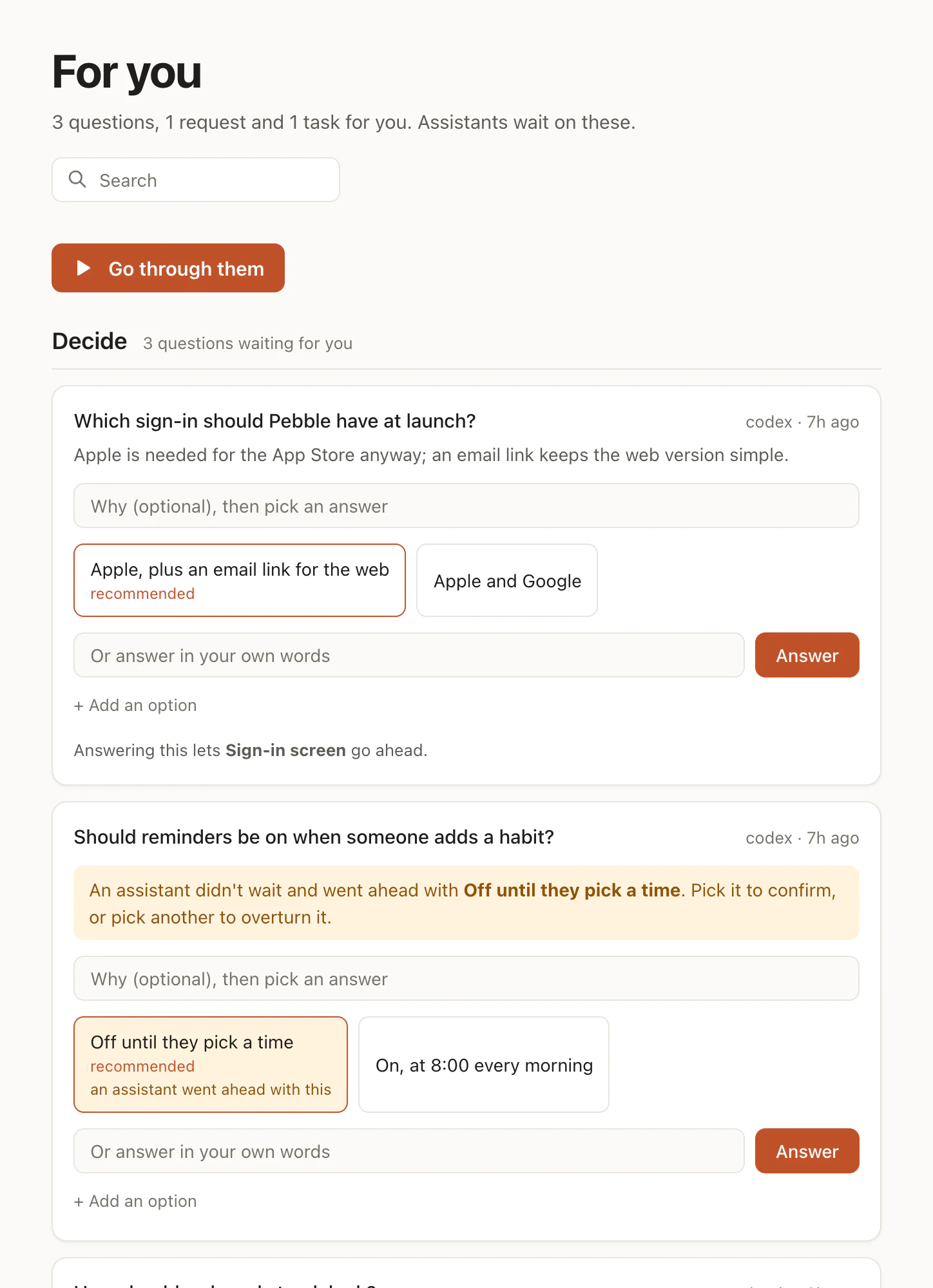
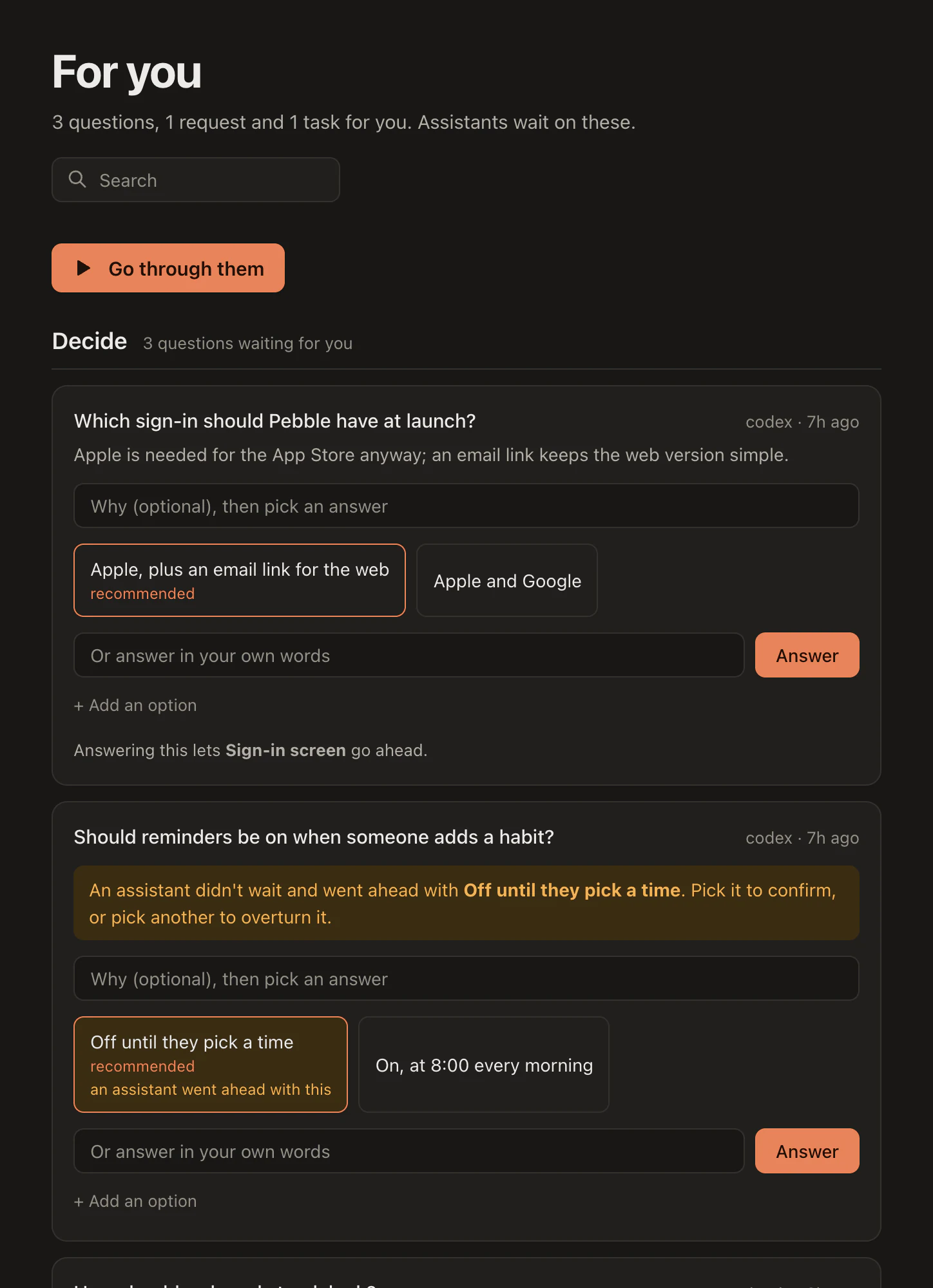
The decisions that are yours. An agent asks a question with options and the one it recommends, or writes a request with the exact steps only you can do, and both wait for you in one place, whichever agent asked:
Coordination without a conductor. Each agent claims what it takes, hears what the others took, finished and noted, and can message the one on a task. Hamloy never decides who does what; the agents keep the plan, and you steer.
Done means merged. With the hamloy program on your computer, the board
follows each task through git: ticked on a branch, merged, pushed.
Using them together
Run your agents in Conductor, Orca or any of the others, and connect those agents to Hamloy the way you connect them anywhere: for Claude Code and Codex, one line in the project's folder (Claude Code, Codex). The runner keeps them apart and shows their diffs; Hamloy keeps the plan they share and shows you where it all stands, from any browser or your phone.
Who Hamloy isn't for
Someone who wants a tool that starts agents and runs them in parallel for them. Hamloy never starts work by itself: from the board you can hand a task to an agent at work, or open one on a computer that said yes, but you start your agents where you like, and Hamloy keeps the overview of what they do. It is also hosted, in the EU: if you need to run it yourself, Orca, Paseo and Herdr are open source.
Questions
Can I use Hamloy with Conductor or Orca?
Yes. An agent one of them starts is still Claude Code or Codex, so it connects to Hamloy like any other, and keeps the same plan as the agents you run elsewhere. The runner runs it; Hamloy shows you what it did and what it needs from you.
Does Hamloy run agents in parallel for me?
No. Hamloy never starts work by itself, and it makes no worktrees or containers. If you want one app to start your agents side by side and review their diffs, use one of these, and Hamloy beside it for the overview.
Then why not just use the runner's own view?
It shows the agents in that app, on that computer, while they run. Hamloy shows every agent's work in one place, whichever app or computer it ran on, and keeps it after the session ends, with the plan, the decisions that are yours and what reached main.
Which is cheaper?
Orca, Paseo, Herdr and Offrun are free, and Conductor is free on your own computer. Hamloy is free for one project, Pro is €8 a month, and a team is €8 a month for each person in it.