Compare
Hamloy alternatives
Hamloy isn't the right tool for every way of working. Here is what to use instead, by the reason you'd look elsewhere.
Updated 17 October 2026
Every fact about another tool here comes from its own site or docs, read on 10 October 2026, and for the runners, dashboards, Vibe Kanban and Backlog.md on 17 October. Where we wrote a full comparison, it's linked.
You want it open source, or to run it yourself
Hamloy is closed and hosted; there is no version to run yourself.
- Beads: an issue tracker for
coding agents that keeps a dependency graph in a Dolt database in your repo,
with a
bdcommand line, atomic claims and a list of what's ready. MIT. Hamloy vs Beads. - Backlog.md: every task a Markdown file in the repo, a board in the terminal and one in your browser on your own machine, for agents through the command line or MCP. MIT. Hamloy vs Backlog.md.
You work offline, or want the list in the repo
Hamloy needs a network: your agents reach it over the internet.
- A TODO.md: free, plain, offline, and reviewed with the code. Hamloy vs a TODO.md.
- Task Master: tasks
in
.taskmaster/tasks/tasks.jsonin the repo, readable by any agent. - Beads and Backlog.md, above.
You want a plan written from a spec
Hamloy calls no model of its own; your agent writes the tasks.
- Task Master reads a PRD and writes tasks with dependencies, subtasks and complexity scores. Hamloy vs Task Master.
- Kiro, an agent with its own IDE, turns a
feature into a spec: requirements, a design, and a
tasks.mdof tasks it can run, independent ones at the same time. It has a free plan; paid plans start at $20 per user a month (pricing).
You want an app that runs your agents for you
Hamloy never starts work by itself; you start your agents where you like.
- Conductor, Orca, Paseo, Herdr and Offrun start Claude Code, Codex and others side by side, most in a git worktree each, with their diffs to review. Hamloy vs the apps that run your agents.
- Vibe Kanban runs agents in workspaces on your computer, each in its own worktree, with diffs, a preview and pull requests. Open source (Apache-2.0), community maintained and fully local since April 2026. Hamloy vs Vibe Kanban.
You only want to see which session is busy
Hamloy keeps the work, not only the sessions' state.
- Claude Code's agent view (
claude agents) shows every Claude Code session on one terminal screen, and comes with Claude Code. Hamloy vs Claude Code's agent view. - AgentPulse and Claude-Code-Agent-Monitor show live sessions on your own machine, open source. Hamloy vs the session dashboards.
You only want a checklist for the session in front of you
Hamloy keeps what outlasts a session: the plan, what was finished and ruled out, and what waits on you, for the next session and for you. If all you want is the steps of the task you're watching, a checklist is enough.
- Claude Code's own task list keeps the steps of the work in front of it, on your computer, and comes with Claude Code. On newer models you turn it on yourself. It works beside Hamloy too: the checklist for the step, the board for the overview. Hamloy vs Claude Code's own to-do list.
- A TODO.md, above.
A team plans its product in a tracker
Hamloy shares projects with other people through a team, but it has no cycles, roadmaps, triage or reports.
- Linear, "the product development system for teams and agents", with an MCP server and agents you delegate an issue to. Hamloy vs Linear.
- GitHub Issues, free with every repository, closed by the pull request that fixes it, and assignable to Copilot, Claude or Codex on paid Copilot plans. Hamloy vs GitHub Issues.
Both work beside Hamloy: the team's issues there, your agents' working list in Hamloy.
When Hamloy is the one
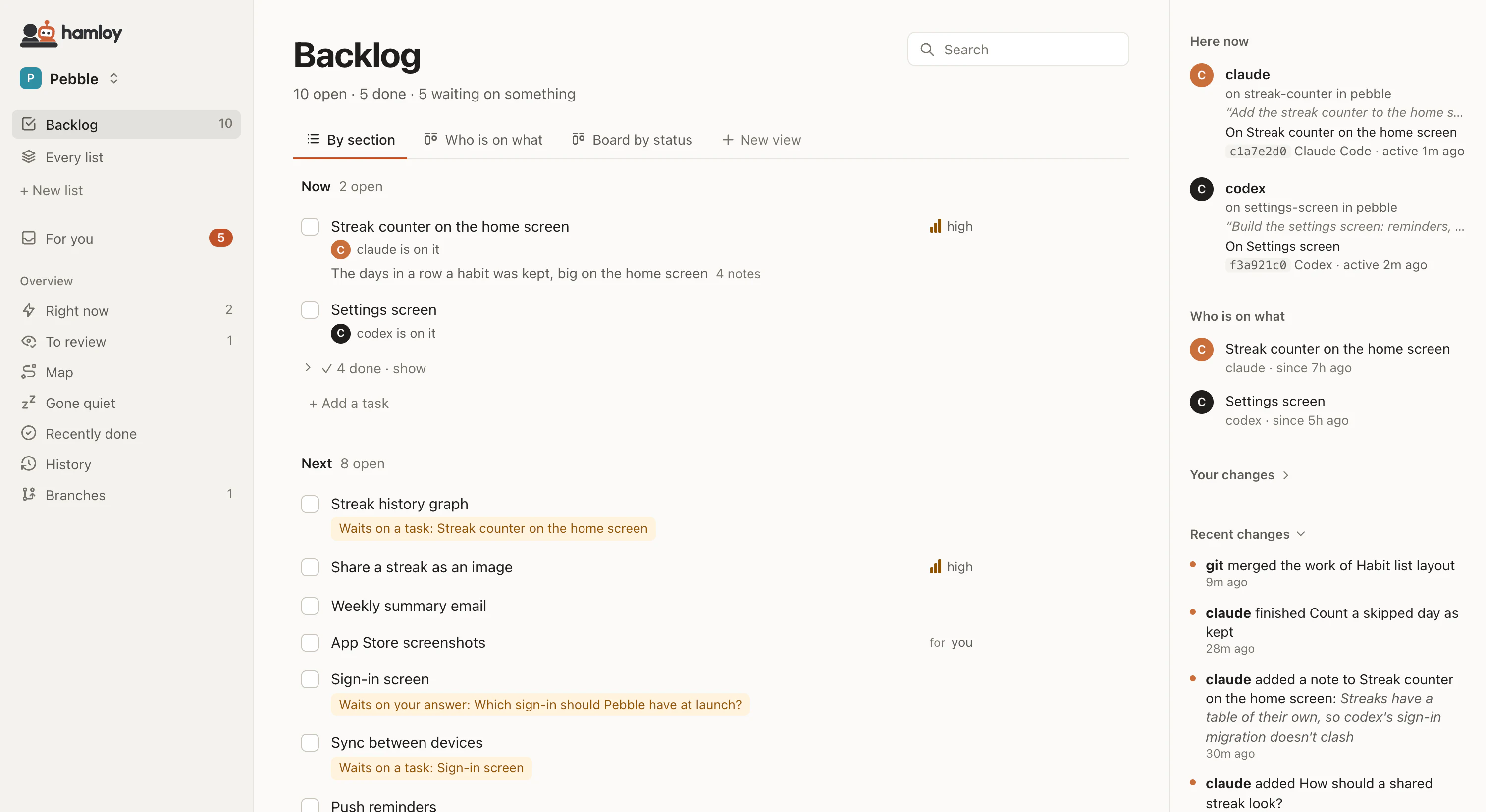
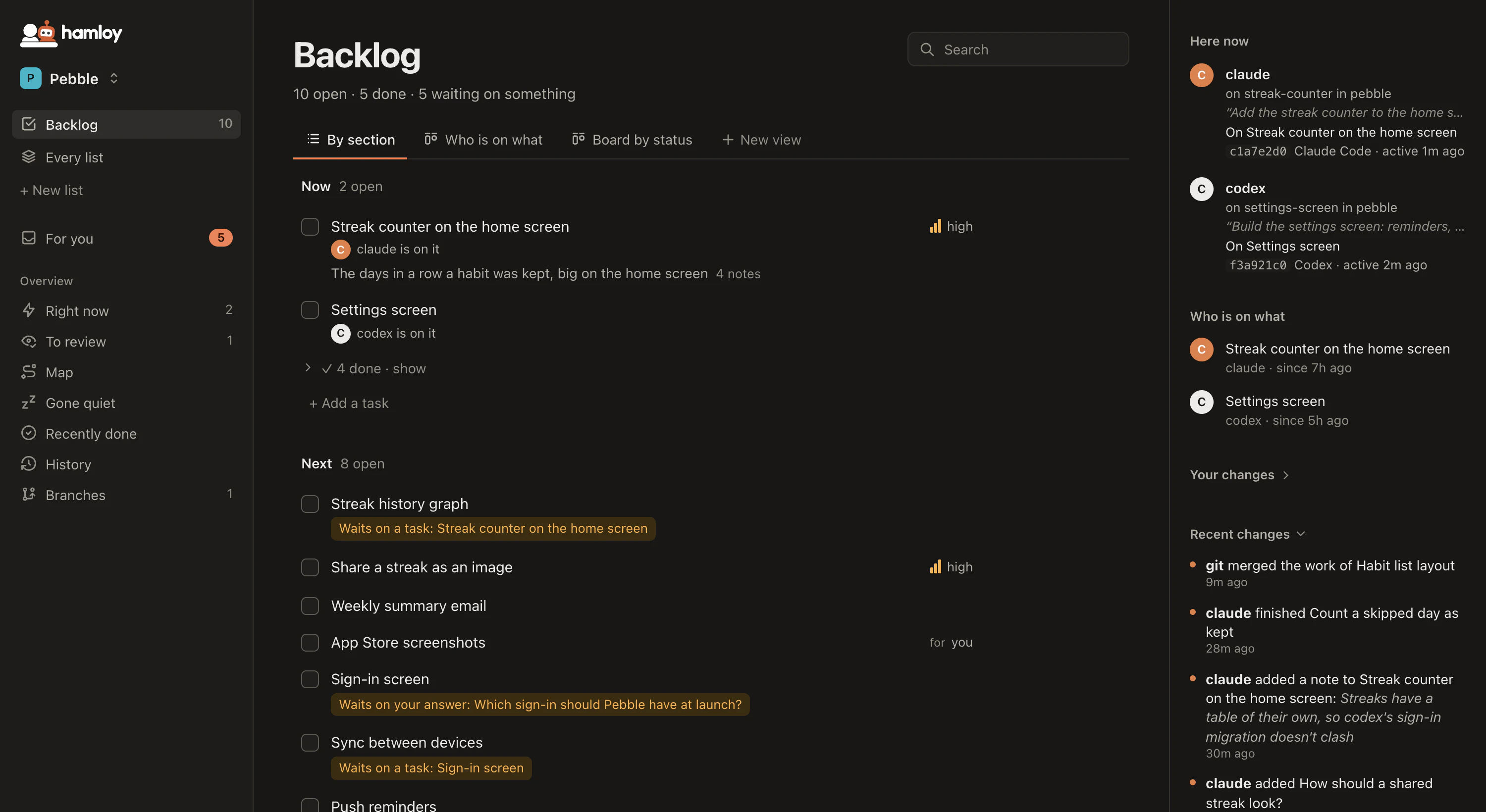
If none of those reasons is yours, Hamloy is built for the overview, with one agent or ten, across Claude Code, Codex, Cursor or Claude. One board shows what each agent is on, what it finished and what it ruled out, in views you arrange yourself; the decisions and steps that are yours wait in one place; the agents claim what they take and message each other; and done is followed through git (the overview, why a shared list).
It's the same board from one session to a team: walk away from one session and it knows what it did; the next session starts where that one stopped; a second agent sees what the first took and finished; a teammate's agents are named for them.
Coordinate your coding agents. Don't orchestrate them. Hamloy never starts work by itself: your agents stay in the tools you start them in, and Hamloy gives them one plan and you one page.
The trackers here, Beads, Backlog.md, Task Master, Linear and GitHub Issues, are set side by side with Hamloy in the best task trackers for AI agents.
Questions
Is there a self-hosted Hamloy?
No. Hamloy is closed and hosted, in the EU; there is nothing to run yourself. Beads and Backlog.md are open source and run on your own machine.
Can I leave Hamloy later?
Yes. Export gives your lists as plain Markdown files any time, on every plan, and nothing is deleted if you stop paying.
Can I try Hamloy before deciding?
Yes. It's free for one project for you alone, with every feature and no card.