Hamloy vs a TODO.md in your repo
A TODO.md is free, plain and kept in git. Hamloy is the overview of your agents' work, from one session to a team, where you answer what's yours.
Updated 17 October 2026
The short answer
A TODO.md is a free, plain checklist kept in git and reviewed with the code. It says what was planned, not what happened: each branch has its own copy, nothing in it says who is on a line or what was ruled out, and it can't bring you a decision while you're away. Hamloy keeps one list for every session, branch, worktree and tool, kept by the agents as they work, and gives you one board where you see what they are on, what they finished and merged and what waits on you, from one session to a team. It still exports as Markdown files.
| Hamloy | A TODO.md | |
|---|---|---|
| What it is for | One page for every agent's work: what each is on, what it finished and merged, what waits on you | A plain list of what's left, for whoever opens the file |
| Where you read it | One live board in the browser, on any machine or your phone, with views as a list, a board or a table; a panel in the terminal | Your editor, or the file's page on your Git host |
| Where it lives | On hamloy.com, one project for the repo; every branch and worktree shares it | In the repo, one copy per branch |
| Who is on what | Each agent claims its task; the board and the other agents see who has it and since when | The file doesn't say; two agents can read the same next line |
| Decisions that are yours | A question with options and the one the agent recommends | Whatever the agent writes in the file or says in chat |
| What only you can do | A request with the exact steps and what it frees | A line in the file, if the agent remembers to write one |
| What done means | Followed through git: done on a branch, merged, pushed | A ticked box, on the branch that ticked it |
| Needs a network | Yes | No |
| Cost | Free for one project; Pro €8 a month; a team €8 a person | Free |
When to choose which
Keep the TODO.md when the list should live with the code, offline and with no account, reviewed in the same pull request as the code it describes, and you only need it while you watch the terminal. It costs nothing.
Choose Hamloy when you want the overview:
- you want to see what your agent did while you were away, on one page, without reading back through the terminal, and from another machine;
- the next session, tomorrow or on another computer, should start where the last one stopped, with what it finished and ruled out;
- several sessions or agents run at once: two Claude Code windows in two worktrees, or Claude Code and Codex on the same repo;
- an agent needs a decision from you and you are not watching its terminal;
- "done" has to mean merged, not ticked on a branch nobody merged.
The questions a file can't answer
A TODO.md says what was planned. Walk away from one agent, or run three, and your questions are about what is happening, and a file on a branch has no way to know. On Hamloy each of them has a page:
- Who is working right now, and on what? Right now: a row for each session with the task it holds.
- What is waiting on me? For you: every decision with its options and every request with its steps, the one that holds up the most work first.
- What got done while I was away, and is it merged? Recently done, day by day, and Branches for what is ticked but not on main yet.
- What did they try that didn't work? The notes under each task, and History, with every change and who made it.
- What has nobody touched for a week? Gone quiet.
- What do I do first to free the rest? The Map.
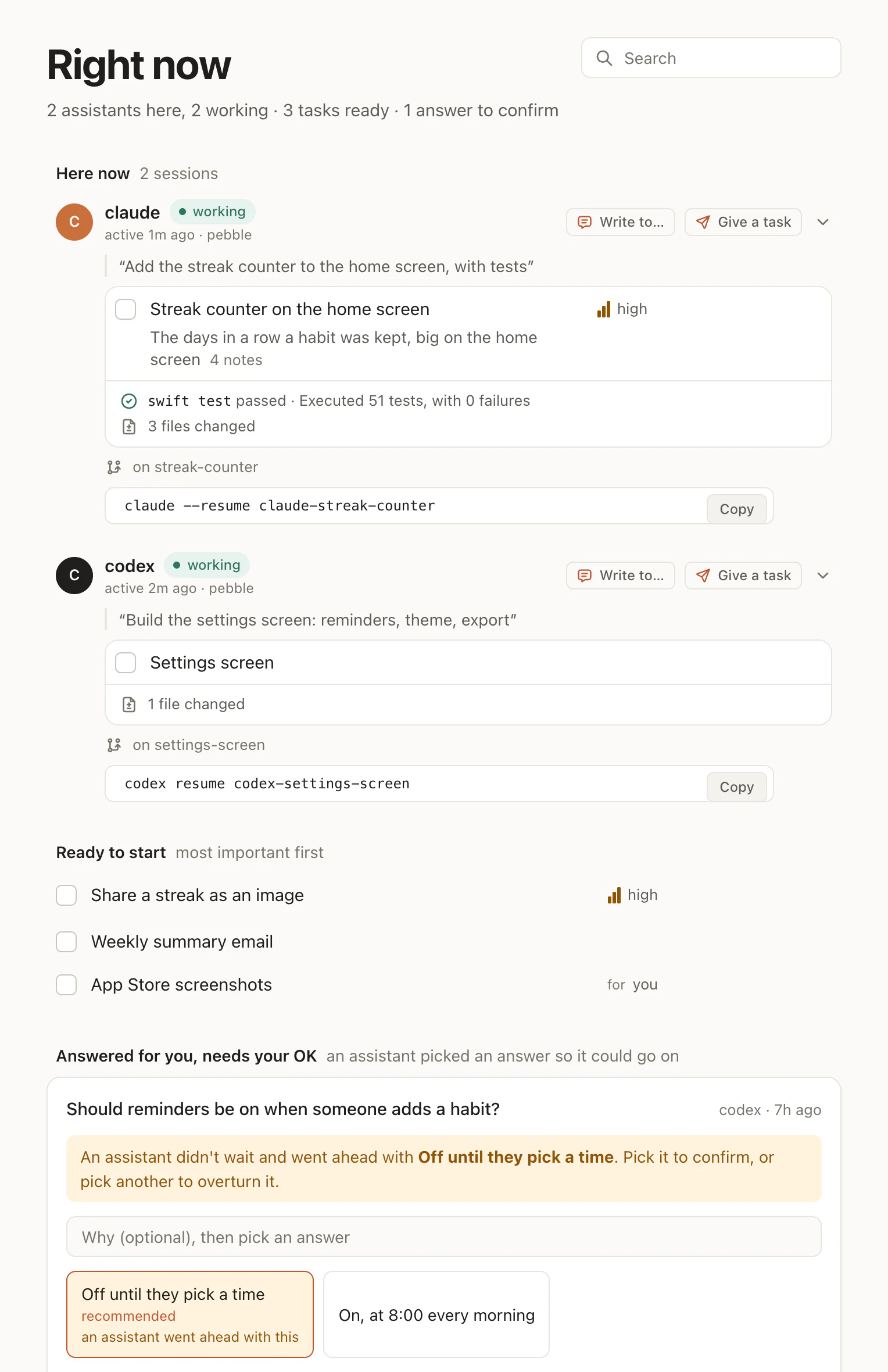
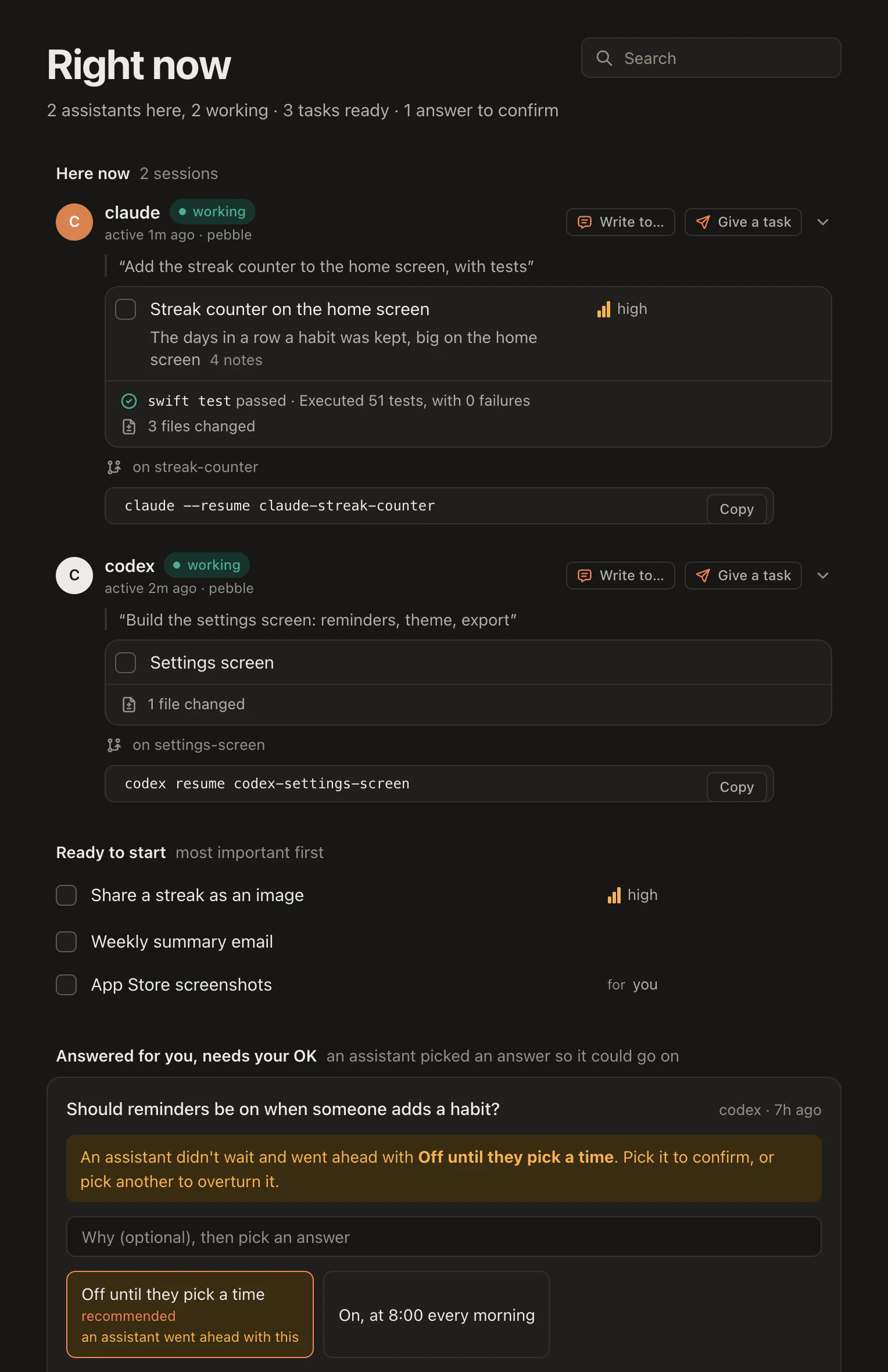
You don't keep these pages up to date. The agents write to the list as they work, and each page is that list, read another way.
Where a TODO.md stops
A TODO.md is a file, so it is on a branch. When Codex ticks "Offline sync" on
feat/offline, the copy on main still says it is open, and the Claude Code
session on main reads it as the next thing to do. Two branches that both change
the list can meet again as a merge conflict in the list itself.
A question an agent writes into the file waits there until you open the file. A question it asks in chat is gone when that session closes, and the next session guesses.
What Hamloy does instead
Every agent calls the same lists through MCP tools, whatever branch or worktree it is in, and writes there what it's on, what it finished and what it ruled out. You read all of it on one board (the overview).
The same lists open the way you want to see them that day: a board with a column per agent or per status, or a table sorted by priority, each kept as a tab (views):
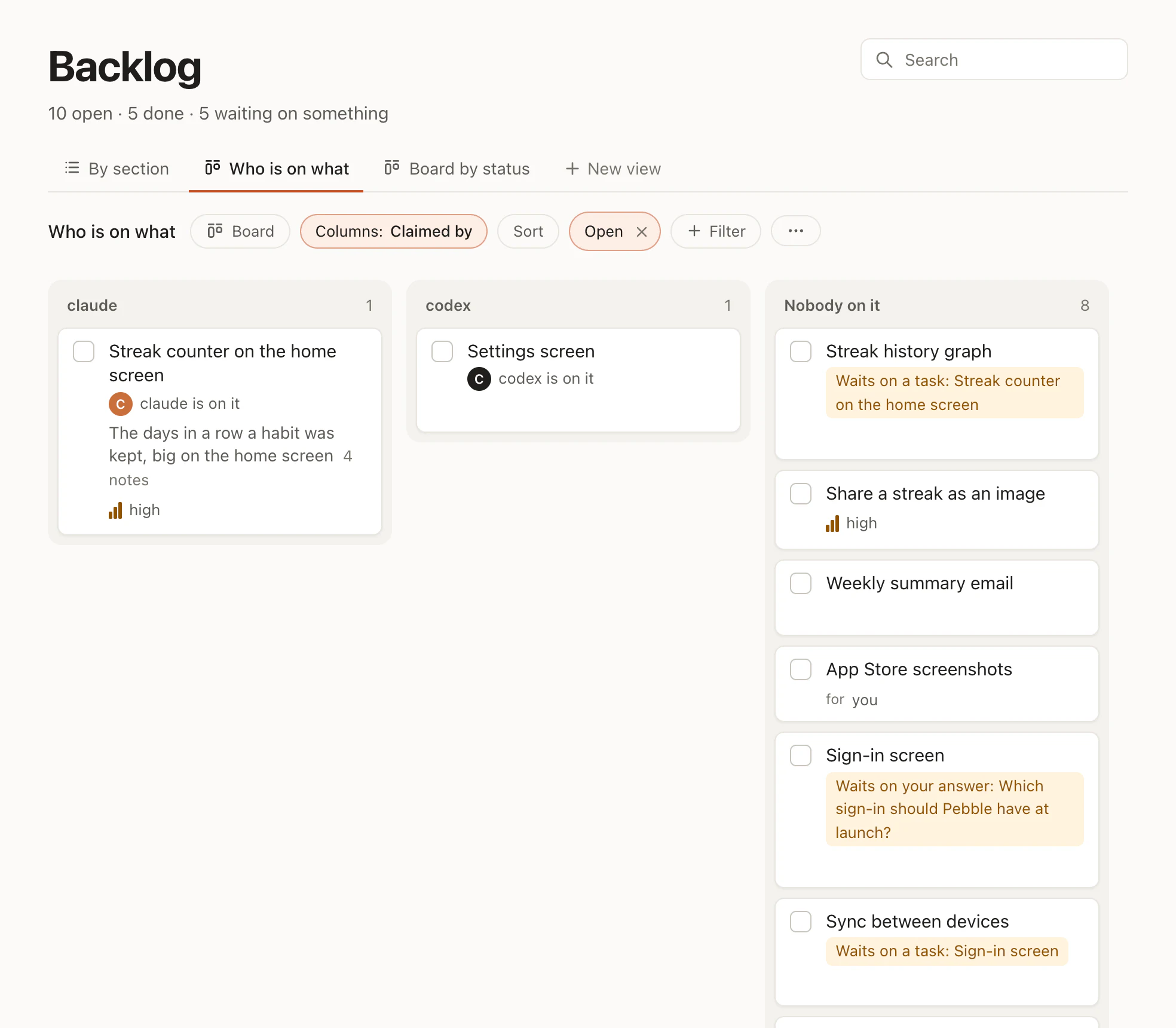
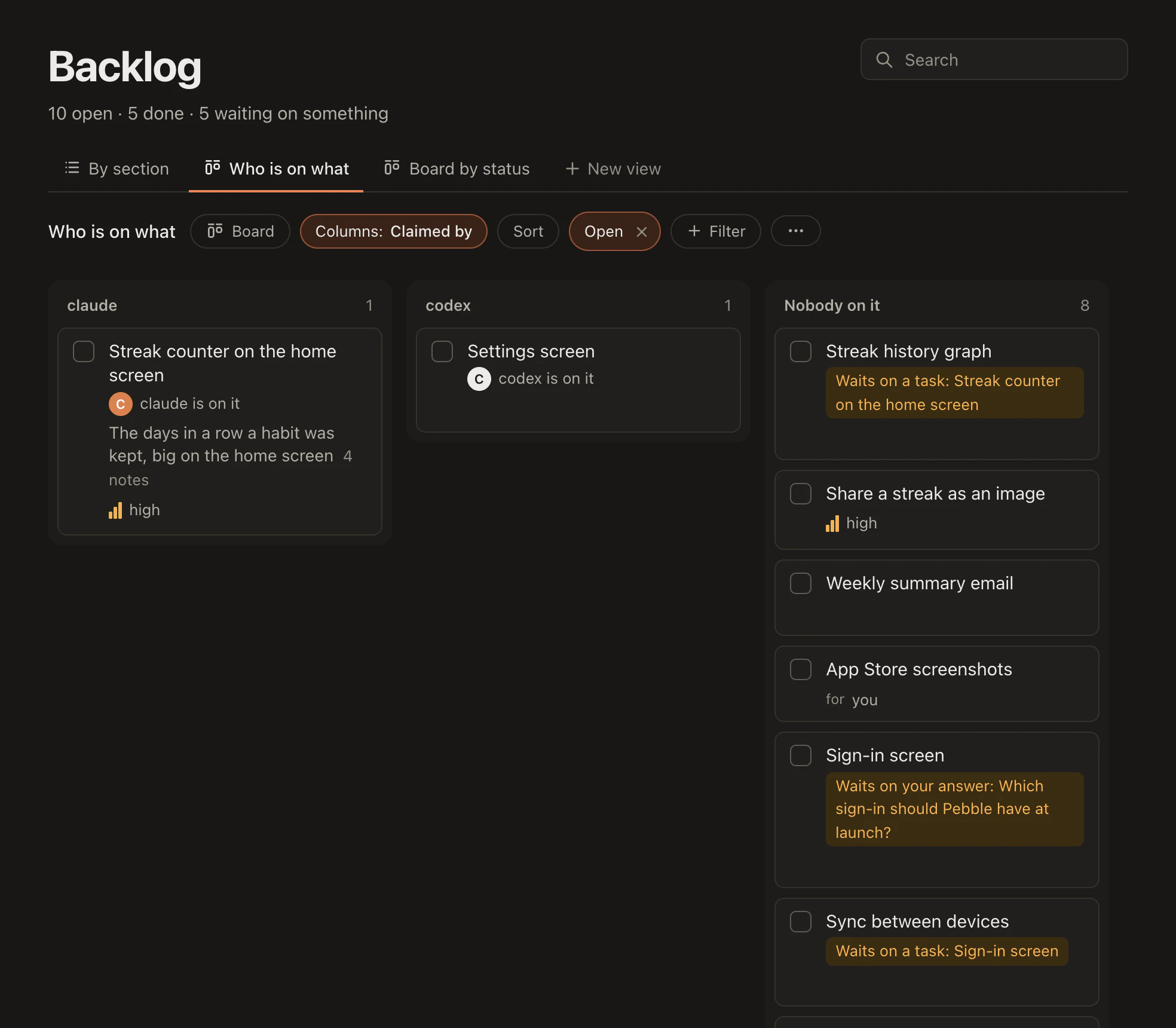
Before an agent starts a task it claims it, so the board, and every other agent, knows who is on it (claims).
A decision that is yours becomes a question with options and the one the agent recommends. You answer on the board, from any machine or your phone, and the agent carries on with its next tool call (questions):
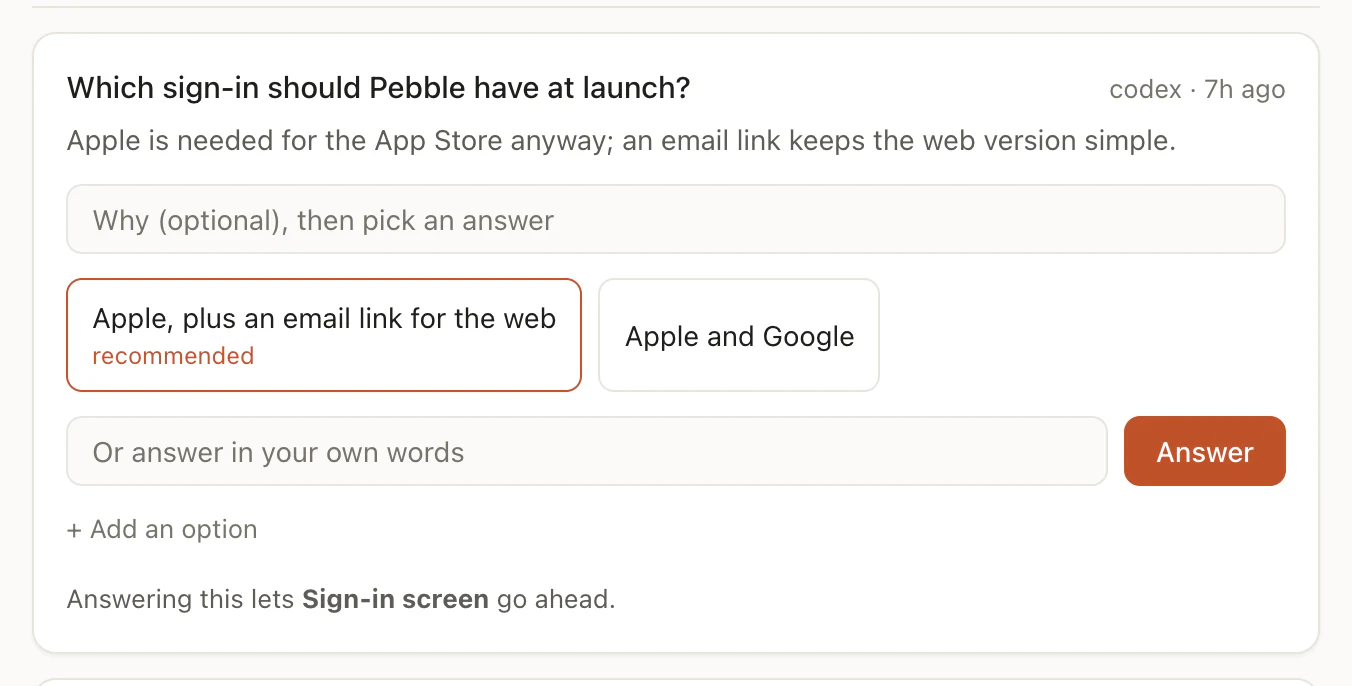
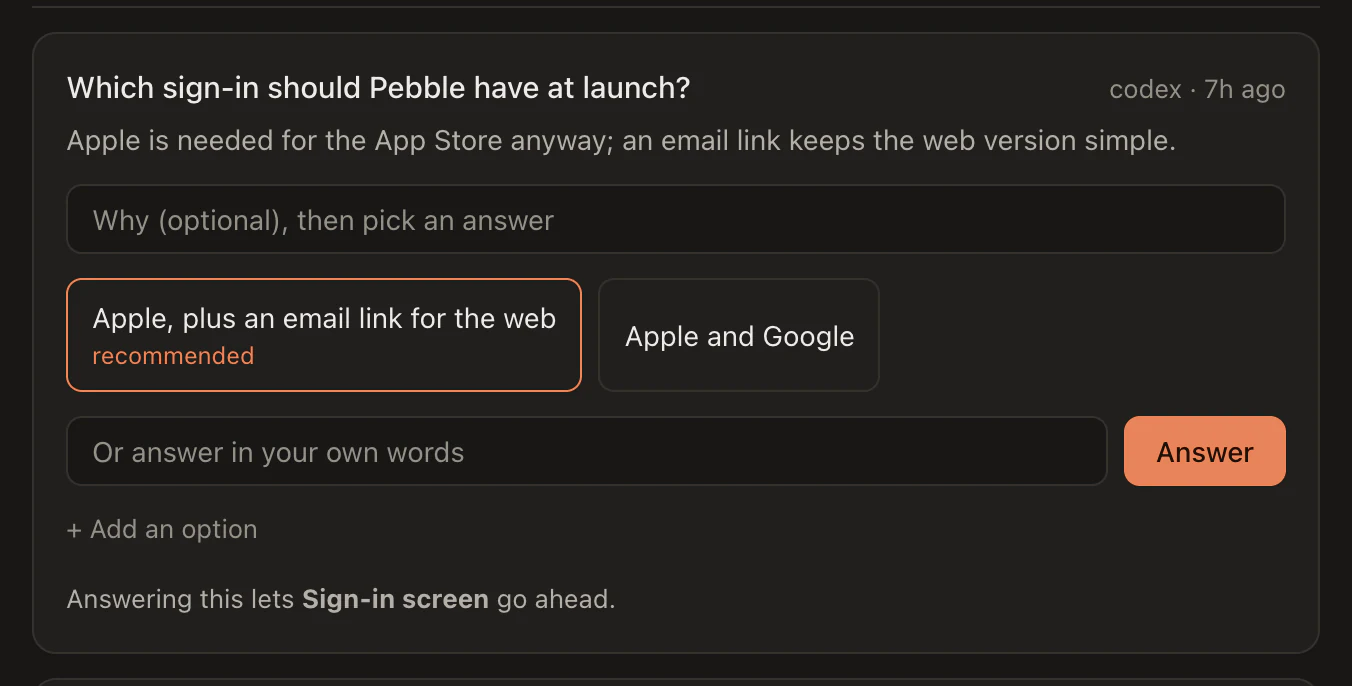
What only you can do (an account, a key, a deploy) goes on Requests with the exact steps (requests). And because Hamloy follows the work through git, a task ticked on a branch shows as "on feat/offline, not merged into main yet" until it is merged and pushed (git).
The lists are still Markdown
You don't give up plain files. A project exports as a ZIP of Markdown files,
backlog.md, requests.md and questions.md, that read like any checklist
(export). A task's key and who added it sit in a comment at the
end of its line:
## Sign-in

- [ ] Sign in with Apple <!-- id:B-k3f9 by:claude at:2026-10-07T13:10 needs:Q-sy2c prio:high -->
  Apple first; the email link comes after.
  - [ ] Keep the token in the Keychain <!-- id:B-x2m4 by:claude at:2026-10-07T13:22 -->
- [x] Dark mode for the habit list <!-- id:B-r5nd by:you at:2026-10-06T09:02 done:2026-10-08T16:40 done-by:codex -->
Your assistant brings the same files back in (import, the Markdown files).
Moving a TODO.md over
Ask your agent. Once it has the Hamloy tools, ask it to bring TODO.md in, or start it on an empty project and it offers to. It brings the whole file in one import: its headings become sections, its boxes tasks, ticked ones done and indented boxes subtasks, and it can turn the lines that are really decisions into questions with options.
Then delete the file, or keep it for what belongs with the code: a roadmap you publish, or notes on a design.
Using both
Some people keep a short TODO.md for the next few hours of one session and Hamloy for everything that outlives it or is shared with another agent. That works, as long as each task lives in one place: an agent that finds the same task in both will not know which one is current.
What each costs
A TODO.md is free. Hamloy is free for one project for you alone, with every feature; Pro is €8 a month or €80 a year for more projects, and a team €8 a month a person for sharing them (pricing).
Questions
Can my agents read the list without a network?
No. Hamloy is hosted, and agents reach it over the internet. If you often work offline, a TODO.md is the better fit.
Does Hamloy see my code?
No. It keeps what agents write to your lists, and where they work (the folder, the repo, the branch and the names of the files they edit), never the files themselves.
Can I go back to a file?
Yes. Export gives the lists as Markdown files any time, on the free plan too, and nothing is deleted if you stop paying.
Does it work with one agent?
Yes. Walk away from one session and the board knows what it did, what it ruled out and what waits on you; the next session starts where that one stopped, with its notes, in another window or on another computer. A TODO.md says what was planned; Hamloy also says what happened.